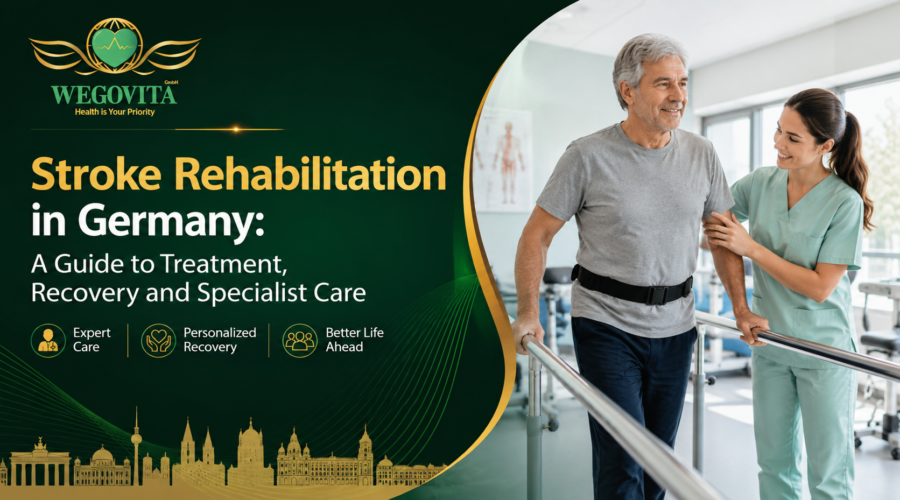
A stroke can affect movement, speech, balance, memory, swallowing, vision, and the ability to manage everyday activities. Recovery is therefore rarely limited to one type of therapy. Stroke rehabilitation in Germany typically involves a coordinated programme that combines medical supervision with physiotherapy, occupational therapy, speech and language therapy, swallowing rehabilitation, cognitive support, and other services according to the patient’s needs.
Germany has an established system of neurological rehabilitation with different levels of care for people recovering from stroke. Rehabilitation may begin during the hospital stay and continue through specialised neurological rehabilitation, outpatient therapy, or longer-term follow-up care. The appropriate pathway depends on the severity of the stroke, the patient’s medical stability, functional limitations, rehabilitation goals, and ability to participate in therapy.
For international patients from the USA, Canada, Iraq, Egypt, Saudi Arabia, and Oman, understanding how stroke rehabilitation works before travelling can make the medical planning process clearer. This guide explains the rehabilitation pathway, therapies, recovery expectations, specialist care, costs and practical considerations involved in seeking stroke rehabilitation in Germany.
Key Takeaways
- Stroke rehabilitation in Germany is multidisciplinary, combining therapies such as physiotherapy, occupational therapy, speech therapy, swallowing rehabilitation, and medical care according to individual needs.
- Rehabilitation can start during the acute hospital phase and continue through specialised neurological rehabilitation or outpatient treatment.
- Germany uses a structured A to F neurological rehabilitation phase model, helping match rehabilitation intensity to a patient’s functional and medical needs.
- Recovery is highly individual. The first months can be particularly important, but meaningful improvements may continue beyond the early recovery period.
- International patients should review medical records, imaging, previous rehabilitation reports, current medications, functional limitations, and rehabilitation goals before selecting a treatment pathway.
- A medical travel coordinator such as WEGOVITA GmbH can help international patients explore appropriate German specialist care and organise the practical steps involved in seeking treatment.
What Is Stroke Rehabilitation?
Stroke rehabilitation is a structured programme designed to help a person regain as much independence and function as possible after a stroke.
A stroke can occur because of a blocked blood vessel, known as an ischaemic stroke, or bleeding in the brain, known as a haemorrhagic stroke. The resulting neurological damage can affect different parts of the brain, so two people who have experienced a stroke may have very different rehabilitation needs.
The goals of rehabilitation may include improving:
- Walking and general mobility
- Arm and hand function
- Muscle strength and coordination
- Balance and posture
- Speech and language
- Swallowing
- Memory and concentration
- Everyday activities
- Cognitive function
- Emotional wellbeing
- Independence at home
- Ability to return to work or other meaningful activities
German health information services describe neurological rehabilitation as a process that can help people regain independence, manage remaining limitations, and address consequences such as paralysis, language difficulties, memory problems, and depression.
The rehabilitation plan should therefore be based on the person’s actual problems and goals rather than simply following a standard programme.
Why Consider Stroke Rehabilitation in Germany?
Germany has a well-established network of neurological rehabilitation services and specialist medical centres. Rehabilitation can take place in inpatient facilities, outpatient settings, or through other forms of continuing care depending on the patient’s condition.
One important feature is the structured neurological rehabilitation pathway. The German phase model uses stages from Phase A through Phase F, reflecting different levels of medical supervision, rehabilitation needs, independence, and long-term support.
Specialist neurological rehabilitation may be particularly relevant for patients who require coordinated treatment for several stroke-related problems at the same time. For example, a patient with weakness on one side, difficulty speaking, swallowing problems, and reduced balance may benefit from a programme involving several professional disciplines.
Germany’s medical rehabilitation framework also supports both inpatient and outpatient rehabilitation. Inpatient rehabilitation provides accommodation and medical support within the rehabilitation facility, while outpatient rehabilitation allows patients to return home after treatment sessions.
For an international patient, the suitability of a particular centre should be assessed medically rather than based solely on location or general reputation.
Understanding the German Neurological Rehabilitation Phases
Germany’s neurological rehabilitation system commonly refers to six phases. The phase model helps healthcare professionals determine the level of rehabilitation and support required.
Phase A: Acute Medical Treatment
Phase A refers primarily to the acute treatment period after the stroke.
Depending on the patient’s condition, treatment may take place in a stroke unit, intensive care unit, or neurological hospital department. The immediate priorities include stabilising the patient, diagnosing the type and cause of stroke, treating acute complications, and reducing the risk of further neurological damage.
Rehabilitation-related activities can begin during this period when medically appropriate.
Phase B: Early Neurological Rehabilitation
Phase B is designed for patients who still require substantial medical and nursing support but can receive early rehabilitation interventions.
The focus may include early mobilisation, positioning, maintaining or improving physical function, preventing complications, and gradually increasing participation in therapeutic activities.
Phase C: Continuing Neurological Rehabilitation
In Phase C, the patient generally has greater ability to participate in rehabilitation but may still need significant support with daily activities.
Therapy can focus more intensively on mobility, communication, self-care, coordination, and functional independence.
Phase D: Further Rehabilitation
Phase D is often associated with more comprehensive rehabilitation after the patient has progressed beyond the earlier stages.
The aim is to improve remaining functional limitations and prepare the patient for greater independence in daily life. Depending on the circumstances, rehabilitation may involve intensive inpatient therapy or other structured services.
Phase E: Follow-Up and Participation
Phase E focuses on longer-term follow-up, participation, and, where appropriate, returning to education or employment.
Rehabilitation may increasingly address practical activities, occupational requirements, social participation, and maintaining the progress achieved during earlier rehabilitation.
Phase F: Long-Term Support
Phase F applies to people who continue to have a high level of care needs despite rehabilitation.
The focus is generally on maintaining function, providing appropriate support, and preserving quality of life.
Not every patient moves through every phase. A person’s rehabilitation pathway depends on medical condition, functional ability, participation, and changing rehabilitation needs.
What Treatments Are Used in Stroke Rehabilitation?
Effective stroke rehabilitation is usually multidisciplinary. The specific combination depends on the patient’s neurological deficits and personal goals.
Physiotherapy After Stroke
Physiotherapy focuses on movement, strength, balance, coordination, posture, and mobility.
A programme may include supported standing, walking practice, balance exercises, strengthening, movement training, and task-specific activities. Treatment intensity should be appropriate for the patient’s medical condition and functional capacity.
Mobility rehabilitation is an important area of neurological rehabilitation in Germany, with German professional guidelines addressing evidence-based approaches for improving walking ability, walking speed, walking distance, and balance after stroke.
Occupational Therapy
Occupational therapy helps patients regain the ability to perform everyday activities.
This may include training for:
- Dressing
- Eating
- Personal hygiene
- Household activities
- Using the affected hand
- Fine motor tasks
- Safe transfers
- Practical activities at home
The objective is not simply to strengthen a limb but to help the patient use their abilities in meaningful daily situations.
Speech and Language Therapy
A stroke can affect speaking, understanding language, reading, writing, and communication.
Speech and language therapy can assess these problems and develop targeted treatment. German stroke guidance has specifically recommended speech therapy for aphasia, including in people with longer-standing speech difficulties.
Communication rehabilitation can also involve strategies that help family members and caregivers communicate more effectively with the patient.
Swallowing Rehabilitation
Some stroke patients experience dysphagia, meaning difficulty swallowing.
This can create nutritional and respiratory risks, making proper assessment important. Rehabilitation may involve swallowing assessment, targeted exercises, dietary modifications, and other measures selected by the clinical team.
German stroke guidance recommends assessment of swallowing problems and consideration of swallowing rehabilitation where appropriate.
Cognitive Rehabilitation
Stroke can affect attention, memory, planning, concentration, and problem-solving.
Cognitive rehabilitation aims to identify these difficulties and help the patient develop strategies for everyday functioning. Neuropsychological assessment may be useful when cognitive changes interfere with independence, communication, work, or social activities.
Management of Spasticity and Pain
Some people develop increased muscle tone or spasticity after stroke. Others experience shoulder pain, neuropathic pain, or other discomfort.
Treatment depends on the cause and severity. Rehabilitation may incorporate positioning, physical therapy, strengthening, functional training, and medical treatments when clinically indicated.
German rehabilitation guidance includes multidisciplinary management of several post-stroke complications, including spasticity, pain, cognitive impairment, dysphagia, and depression.
How Long Does Stroke Rehabilitation Take in Germany?
There is no universal rehabilitation duration for stroke.
A person with a relatively mild stroke may need a shorter rehabilitation programme, while someone with significant neurological impairment may require a longer period of intensive rehabilitation followed by outpatient therapy or continuing care.
German health information states that inpatient rehabilitation measures commonly have a standard duration of around three weeks, although extensions can be possible when medically justified. This information mainly describes the German healthcare system and should not be interpreted as a fixed treatment duration for international self-pay patients.
For stroke specifically, rehabilitation can continue after discharge. The German Institute for Quality and Efficiency in Health Care notes that rehabilitation is particularly important during the first six months, when many people experience substantial improvements, while longer-term treatment may also remain useful depending on the individual’s condition.
The right question is therefore not simply, “How many weeks of rehabilitation are needed?”
A better question is:
What level of rehabilitation is medically appropriate, what functional goals are realistic, and how will progress be measured?
What Recovery Can Patients Expect After a Stroke?
Stroke recovery varies considerably.
Some patients regain substantial function, while others continue to experience physical, communication, cognitive, or emotional difficulties. Recovery depends on factors such as the type and location of the stroke, severity of neurological injury, complications, general health, rehabilitation participation, and the specific functions affected.
The early months can be especially important, but recovery does not necessarily stop after this period. Evidence and specialist clinical experience indicate that some patients can continue to make functional improvements later, particularly when treatment is targeted to remaining deficits and meaningful goals.
For example, a patient who can walk independently but struggles with stairs may have a very different rehabilitation goal from someone who cannot yet stand without assistance.
A personalised programme might therefore focus on stair training for the first patient and basic transfers and supported standing for the second.
This illustrates why rehabilitation should be based on individual assessment rather than a generic exercise programme.
What Should International Patients Prepare Before Travelling to Germany?
Patients travelling from the United States, Canada, Iraq, Egypt, Saudi Arabia, or Oman should prepare their medical information before contacting a German rehabilitation provider.
Useful documentation can include:
- Recent neurological and medical reports
- Stroke diagnosis and date
- Brain imaging reports and available imaging files
- Current medication list
- Previous surgery or procedure information
- Rehabilitation reports
- Physiotherapy and occupational therapy assessments
- Speech and swallowing assessments where applicable
- Information about mobility and daily activities
- Details of existing medical conditions
- Current functional limitations
- The patient’s main rehabilitation goals
It is helpful to describe abilities in practical terms.
For example, instead of simply stating “left-sided weakness,” information such as “can stand with assistance but cannot walk independently” gives a rehabilitation team more useful context.
A German specialist can then determine whether the available medical information is sufficient for an initial assessment and whether further evaluation is needed.
How Is a Stroke Rehabilitation Programme Planned?
A good rehabilitation programme begins with assessment.
The medical team considers the patient’s neurological condition, physical abilities, communication, cognition, swallowing, psychological wellbeing, independence, and ability to participate in therapy.
Rehabilitation goals should then be specific and meaningful.
Examples might include:
- Walking safely with an appropriate aid
- Improving use of the affected arm
- Performing personal care independently
- Communicating basic needs
- Eating and drinking more safely
- Improving balance
- Returning to selected work activities
- Reducing dependence on caregivers
German stroke guidance emphasises defining personal rehabilitation goals and reviewing those goals regularly as the patient’s condition changes.
This goal-based approach is important because rehabilitation is not simply a collection of therapy sessions. It is a process aimed at improving real-world function and participation.
How Much Does Stroke Rehabilitation in Germany Cost?
The cost of stroke rehabilitation in Germany depends on several factors, including:
- The patient’s medical condition
- Rehabilitation phase
- Inpatient or outpatient treatment
- Length of stay
- Level of medical supervision
- Number and type of therapies
- Diagnostic requirements
- Accommodation arrangements
- Additional services for international patients
There is no single reliable price that applies to every international stroke rehabilitation case.
Patients from outside Germany should also distinguish between rehabilitation covered through the German statutory healthcare system and self-funded international medical treatment. The payment and approval process can be substantially different.
For German residents, rehabilitation costs may involve statutory health insurance, pension insurance, or another responsible payer depending on the individual’s circumstances. German government health information explains that the responsible rehabilitation provider depends on the patient’s medical and employment situation.
International patients should therefore request an individual treatment and cost assessment before making travel arrangements.
How WEGOVITA Can Help International Patients Explore Care in Germany
For an international patient, arranging medical care abroad involves more than identifying a hospital.
Medical records need to be collected, translated when necessary, reviewed by appropriate specialists, and matched with a suitable treatment pathway. Travel arrangements, communication, scheduling, and coordination can also require careful planning.
WEGOVITA GmbH supports international patients seeking medical treatment in Germany by helping coordinate access to German medical expertise and supporting the organisational side of the medical travel process.
For patients considering neurological rehabilitation, the most useful starting point is usually a review of the patient’s existing medical documentation and rehabilitation history. This allows the appropriate German medical team to assess the case and determine whether the proposed rehabilitation pathway is suitable.
Patients and families can learn more through WEGOVITA GmbH.
What Should You Look for in a German Stroke Rehabilitation Centre?
Choosing a rehabilitation centre should be based on clinical suitability rather than marketing claims.
Important questions include:
- Does the centre provide neurological rehabilitation?
- Does it treat stroke patients with similar functional needs?
- Which rehabilitation phases does it support?
- Is there access to neurologists and rehabilitation physicians?
- Which therapies are available?
- Can the programme address speech and swallowing difficulties?
- How is progress measured?
- How frequently are rehabilitation goals reviewed?
- Can the centre manage relevant medical complications?
- What information is required before admission?
- What is included in the proposed treatment package?
- Can international patients receive appropriate communication support?
The best facility for one patient may not be appropriate for another. A person requiring intensive neurological and nursing support has different needs from someone seeking outpatient therapy for residual mobility or communication problems.
Stroke Rehabilitation and the Role of Family Members
Family involvement can make rehabilitation more practical and sustainable.
Relatives may need to understand how to support safe mobility, communication, daily activities, medication routines, and follow-up therapy. They can also provide valuable information about the patient’s abilities before the stroke and the changes observed after it.
However, family members should not be expected to replace professional rehabilitation.
The rehabilitation team should explain appropriate assistance and identify situations where professional support is required.
Planning for discharge is equally important. Before returning home, patients may need guidance regarding mobility, home safety, assistive equipment, continued therapy, and follow-up medical care.
Why Follow-Up Care Matters After Rehabilitation
Completing an inpatient rehabilitation programme does not necessarily mean that recovery is finished.
Some patients continue with outpatient physiotherapy, occupational therapy, speech therapy, or other specialist care after returning home. Follow-up also provides an opportunity to reassess functional limitations and modify rehabilitation goals.
The German medical community is continuing to develop approaches for coordinated stroke aftercare, with emphasis on collaboration across healthcare sectors and professional disciplines and on patient-centred care.
For international patients, it is useful to ask before discharge:
What should happen after returning home?
A written rehabilitation summary, treatment recommendations, functional assessment, medication information, and follow-up plan can help the patient’s local healthcare team continue appropriate care.
Questions to Ask Before Choosing Stroke Rehabilitation in Germany
Before committing to treatment, patients and families should obtain clear answers about the proposed programme.
Ask about the patient’s expected rehabilitation phase, therapy goals, treatment frequency, medical supervision, estimated duration, costs, accommodation, language support, discharge planning, and follow-up recommendations.
It is also reasonable to ask how progress will be evaluated.
A useful rehabilitation programme should have measurable objectives rather than simply promising “intensive therapy.”
Conclusion
Stroke rehabilitation in Germany can provide a structured pathway for patients who need specialised neurological rehabilitation following a stroke. Treatment may involve physiotherapy, occupational therapy, speech and language therapy, swallowing rehabilitation, cognitive support, medical management, and long-term follow-up according to individual needs.
Germany’s phase-based neurological rehabilitation model helps organise care according to the patient’s level of medical and functional support. Rehabilitation may begin during the hospital stay and continue through specialised inpatient or outpatient services.
For international patients from the USA, Canada, Iraq, Egypt, Saudi Arabia, and Oman, careful preparation is essential. Medical records, imaging, rehabilitation history, current functional abilities, and personal goals can help German specialists assess the most appropriate treatment pathway.
If you are exploring specialist stroke rehabilitation in Germany for yourself or a family member, visit WEGOVITA GmbH to learn more about arranging medical care in Germany and taking the next step towards an individually assessed rehabilitation pathway.
Frequently Asked Questions About Stroke Rehabilitation in Germany
1. What is stroke rehabilitation in Germany?
Stroke rehabilitation in Germany is a structured programme designed to help patients recover functional abilities and improve independence after a stroke. Depending on the patient’s needs, it can include physiotherapy, occupational therapy, speech therapy, swallowing rehabilitation, cognitive rehabilitation, medical supervision, and continuing care.
2. When should stroke rehabilitation begin?
Rehabilitation can begin during the acute hospital stay when the patient’s medical condition allows it. After acute treatment, rehabilitation may continue through early neurological rehabilitation, inpatient rehabilitation, outpatient care, or other appropriate services.
3. How long does stroke rehabilitation take in Germany?
There is no fixed duration for every stroke patient. The length of rehabilitation depends on the severity of neurological impairment, rehabilitation goals, progress, medical requirements, and the type of treatment setting. German rehabilitation measures often have standard periods that can be extended when medically justified, but international self-funded treatment arrangements require individual assessment.
4. Can patients from the USA, Canada, or Middle East receive stroke rehabilitation in Germany?
International patients can explore medical treatment and rehabilitation in Germany, but eligibility, admission, documentation, treatment availability, and payment arrangements depend on the individual case and provider. Patients should obtain a medical assessment and cost estimate before travelling.
5. What therapies are commonly included in stroke rehabilitation?
Common rehabilitation services include physiotherapy, occupational therapy, speech and language therapy, swallowing rehabilitation, cognitive rehabilitation, fitness and mobility training, and medical management of stroke-related complications. The exact programme should be personalised to the patient’s condition.
6. Is stroke recovery possible after six months?
Yes. Although significant recovery often occurs during the early months after stroke, some patients can continue to make improvements later. The potential for further progress depends on the individual’s neurological condition, remaining limitations, rehabilitation goals, and response to treatment.
7. What medical documents are needed for stroke rehabilitation in Germany?
Patients should generally prepare relevant medical and rehabilitation records, including the stroke diagnosis, neurological reports, imaging, medication information, previous therapy reports, functional assessments, and details of current limitations. The exact documents required vary by provider.
8. How much does stroke rehabilitation in Germany cost?
There is no universal price. Costs depend on treatment intensity, rehabilitation setting, duration, medical supervision, therapies, accommodation, diagnostics, and additional international-patient services. Patients should request an individual quotation based on their medical case before travelling.
9. How can WEGOVITA help with medical treatment in Germany?
WEGOVITA GmbH helps international patients explore and coordinate medical treatment in Germany. For stroke rehabilitation, the process can begin with collecting relevant medical records so that an appropriate German specialist or facility can assess the patient’s case and potential rehabilitation pathway.